



.png)
Asian Games 2026: China to India
The Asian Games 2026 delivered a memorable celebration of sporting excellence, bringing together athletes from across Asia in Aichi-Nagoya, Japan, from September 19 to October 4. With 43 sports and 469 gold medals at stake, the competition provided a platform for established sporting powerhouses, emerging nations and individual athletes to make history. China once again finished at the top of the medal table, while host nation Japan recorded its best-ever Asian Games gold-medal haul. South Korea secured third place, and India finished fourth after a campaign filled with historic victories. Uzbekistan, Iran and Thailand also enjoyed strong performances. From record-breaking swimming and athletics to dramatic team finals, the Games showed the depth and diversity of sport across Asia.
Asian Games 2026: Final Country-Wise Medal Table
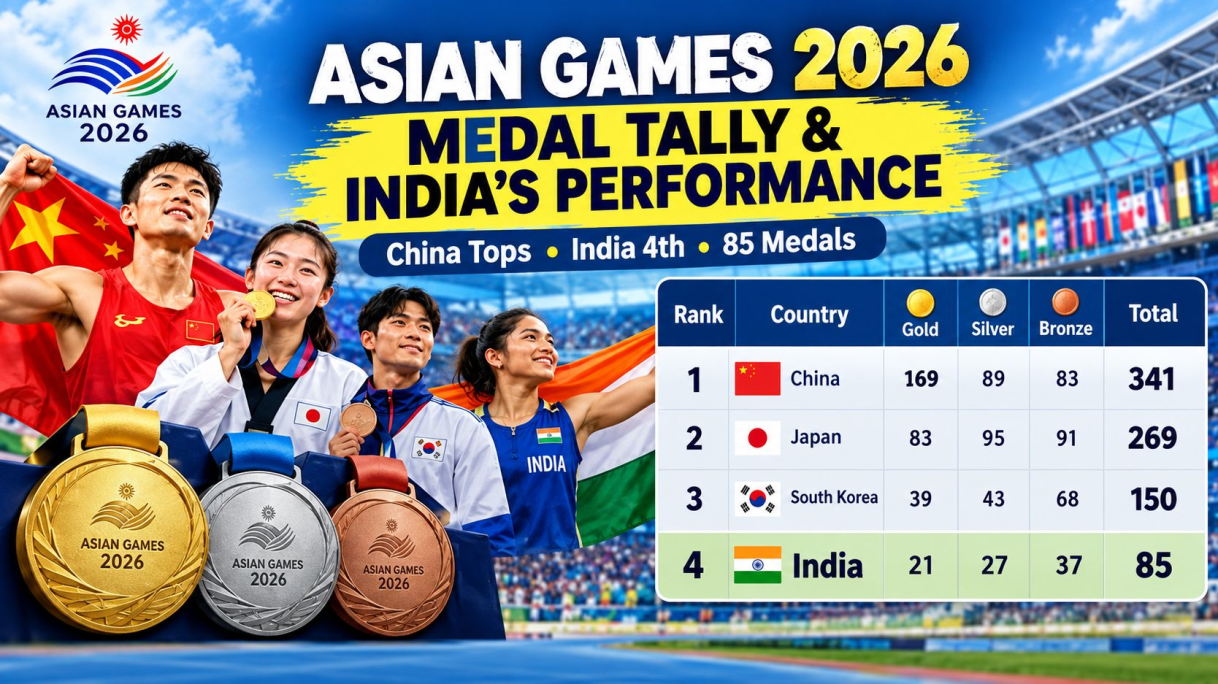
China led the standings with 169 gold medals, followed by Japan with 83. South Korea completed the top three, while India and Uzbekistan finished level on 21 gold medals. India secured fourth place because it won more silver medals.
| Rank | Country | Gold | Silver | Bronze | Total |
| 1 | China | 169 | 89 | 83 | 341 |
| 2 | Japan | 83 | 95 | 91 | 269 |
| 3 | South Korea | 39 | 43 | 68 | 150 |
| 4 | India | 21 | 27 | 37 | 85 |
| 5 | Uzbekistan | 21 | 25 | 24 | 70 |
| 6 | Iran | 19 | 18 | 15 | 52 |
| 7 | Thailand | 18 | 13 | 21 | 52 |
| 8 | Kazakhstan | 12 | 24 | 48 | 84 |
| 9 | Hong Kong | 11 | 19 | 24 | 54 |
| 10 | Bahrain | 11 | 5 | 6 | 22 |
Source: Final Asian Games 2026 medal standings. Countries are ranked by gold medals, followed by silver and bronze medals.
China: The Undisputed Asian Sporting Powerhouse
China once again demonstrated why it remains Asia's leading sporting nation. With 169 gold medals and 341 medals overall, it finished comfortably ahead of every other country. Its success was built across multiple disciplines, including swimming, where young stars delivered outstanding performances. Thirteen-year-old Yu Zidi won three swimming gold medals and was named Female Most Valuable Player of the Games. Teammate Zhang Zhanshuo also enjoyed a remarkable campaign, winning seven gold medals. China's performance extended its run of finishing first at every Asian Games since 1982. Although its final total was lower than the 201 gold medals it won at Hangzhou in 2023, its dominance in Aichi-Nagoya remained unmistakable. For China, the 2026 Asian Games reinforced the strength of its athlete development programmes and its ability to compete across a wide range of sports.
Japan: A Record-Breaking Campaign on Home Soil
Japan made the most of its home advantage, finishing second with 83 gold medals and 269 medals overall. The gold-medal total surpassed its previous Asian Games record of 78, set in 1966. The hosts enjoyed success in several sports, including swimming, athletics and team competitions. Japan's campaign also featured standout performances from emerging athletes, while the introduction of new sports gave local fans additional reasons to celebrate. However, the Games were not without challenges. Transport delays, accommodation problems and disappointing spectator numbers attracted criticism during the event. Despite these organisational difficulties, Japan's athletes delivered a historic result. The final standings highlighted an important distinction: China remained the continent's dominant sporting nation, but Japan demonstrated that it could achieve exceptional results on home soil.
South Korea: Strong Performances in Football and Golf
South Korea finished third with 39 gold medals and 150 medals overall, maintaining its position among Asia's strongest sporting nations. One of the country's biggest moments came in men's football. South Korea defeated host nation Japan 1–0 in the final, securing its fourth consecutive Asian Games gold in the men's tournament. Golf also provided a memorable story. Tom Kim won the men's individual gold medal after a final-round 64, finishing three strokes clear of his closest competitors. The victory also earned him an exemption from South Korea's compulsory military service requirements. These achievements illustrated the importance of both team strength and individual performance in South Korea's campaign. Football delivered a major national triumph, while golf produced a personal milestone with consequences extending beyond the competition itself.
India: Historic Golds and a Fourth-Place Finish
India finished fourth with 21 gold, 27 silver and 37 bronze medals, bringing its total to 85. The result placed India ahead of Uzbekistan, Iran and Thailand on the final medal table. Several victories stood out during the Indian campaign. The men's hockey team won gold, successfully defending its Asian Games title and securing qualification for the Los Angeles 2028 Olympics. India's women's hockey team also produced a historic moment, defeating China 1–0 in the final to win its first Asian Games gold in the sport since 1982. In golf, Pranavi Urs became India's first individual gold medallist in the women's event. Archer Kumkum Anil Mohod won individual recurve gold, while the women's recurve team ended South Korea's long-standing dominance in the event. India also enjoyed a strong boxing campaign, winning three gold medals. Lovlina Borgohain became only the second Indian woman to win Asian Games boxing gold, following Mary Kom. These results demonstrated that India's medal prospects extended well beyond its traditional strengths. Hockey, golf, archery and boxing all contributed to a campaign that combined established success with important breakthroughs.
Uzbekistan: Matching India's Gold Medal Count
Uzbekistan finished fifth with 21 gold medals and 70 medals overall, matching India's gold tally but finishing behind it on silver medals. The country's athletes remained competitive across several disciplines, including combat sports and weightlifting. Uzbekistan's strong performance reflected its growing presence in regional competition and its ability to challenge larger sporting nations. Finishing among the top five was a significant achievement, especially in a Games featuring established medal powerhouses such as China, Japan and South Korea. Uzbekistan's campaign also demonstrated why gold medals alone do not determine the final ranking: its 25 silver medals were two fewer than India's 27, placing it one position lower despite winning the same number of golds.
Iran and Thailand: Strong Campaigns Beyond the Top Five
Iran finished sixth with 19 gold medals, while Thailand placed seventh with 18. Both nations finished with 52 medals, but Iran ranked higher because it won more gold medals. Iran continued to show strength in combat sports, including taekwondo. Arian Salimi added another major achievement to his career by winning the men's heavyweight taekwondo title. Thailand's campaign was led by sprinter Puripol Boonson, who won gold in both the 100 metres and 200 metres. His 100m time of 9.90 seconds set a Games record, while his 200m performance of 19.88 seconds equalled the Asian record. He was subsequently named Male Most Valuable Player. Thailand's overall medal position did not tell the whole story. Boonson's sprint double was one of the most memorable individual achievements of the Games and underlined the country's potential in international athletics.
Kazakhstan, Hong Kong and Bahrain: Nations Worth Watching
The next group of nations also produced notable performances. Kazakhstan finished eighth with 12 gold medals and 84 medals overall. Its 48 bronze medals gave it one of the largest overall medal totals outside the top seven, demonstrating the breadth of its podium finishes. Hong Kong placed ninth with 11 gold medals. One of its standout achievements came in men's tennis, where Coleman Wong won the singles title, securing a historic victory for the territory. Bahrain rounded out the top ten with 11 gold medals. Distance runner Winfred Yavi was a major star, winning the women's 5000m, 10,000m and 3000m steeplechase. She became the first athlete in Asian Games history to win all three events at the same edition. These performances showed that success at the Asian Games is not limited to the countries at the top of the overall table. Individual champions can create sporting history and raise the profile of their nations even when their total medal count is comparatively small.
What the Asian Games 2026 Medal Table Tells Us
The final standings reveal three important trends in Asian sport. First, China continues to lead the continent by a considerable margin. Its 169 gold medals were more than the combined gold totals of Japan, South Korea, India and Uzbekistan. Second, Japan's record haul showed the benefits of a successful home campaign, even though hosting the event brought logistical challenges. Third, competition below the top two remains intense. India, Uzbekistan, Iran and Thailand all secured at least 18 gold medals, while countries such as Kazakhstan, Hong Kong and Bahrain produced memorable individual achievements. The Games also highlighted the importance of investing in younger athletes. Performances from Yu Zidi and Puripol Boonson offered a glimpse of the next generation of Asian sporting stars.
Asia's Sporting Landscape Continues to Evolve
The Asian Games 2026 delivered a compelling mix of dominance, breakthroughs and historic performances. China remained firmly at the top, Japan celebrated a record-breaking home campaign, and South Korea maintained its place among the continent's leading sporting nations. India's fourth-place finish was marked by historic victories across hockey, golf, archery and boxing. Meanwhile, Uzbekistan, Iran, Thailand and other nations showed that the race for regional sporting success is becoming increasingly competitive. Ultimately, the medal table tells only part of the story. Behind every gold, silver and bronze medal are years of training, personal sacrifice and national ambition. As attention turns towards the next Asian Games in Doha in 2030, the performances in Aichi-Nagoya have given fans plenty to remember—and plenty to anticipate from Asia's sporting future.
Cover credits NDTV Sports

Leave a Reply