



.png)
FIFA World Cup 2026: Records Broken, History Made
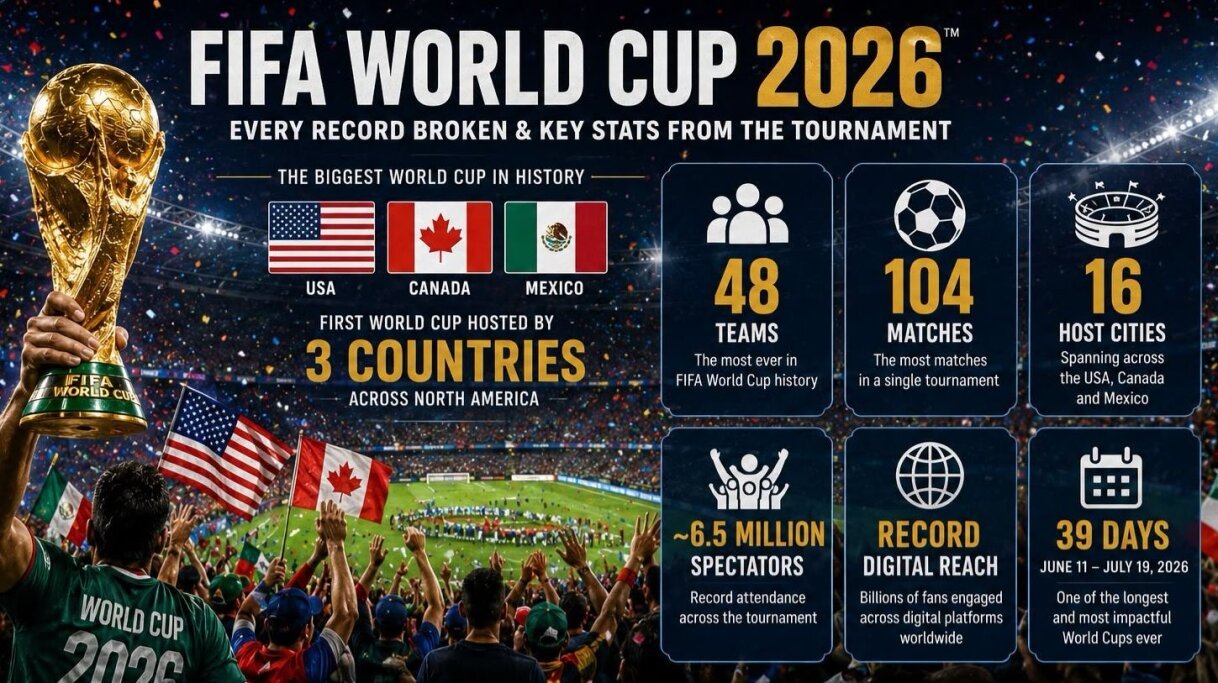
The FIFA World Cup 2026 was never going to be an ordinary tournament. Even before the first ball was kicked, it carried the weight of history. This was the first men’s World Cup to feature 48 teams, the first to be hosted by three countries — Canada, Mexico and the United States, and the biggest edition the competition had ever seen, spread across 16 host cities and 104 matches. And by the time it ended, the tournament had done exactly what big sporting events dream of doing: it had left the game looking bigger, louder and more global than before.
New Format of 48 Teams
FIFA described it as a tournament with “a number of firsts,” while Reuters called it the largest World Cup in history with 48 teams, 1,248 players and 104 matches. The 2026 tournament was not just an expanded World Cup on paper; it felt different in reach and rhythm. Reuters reported that nearly a quarter of FIFA’s 211 member associations made it to the North American tournament, making it the most global World Cup ever staged. FIFA, meanwhile, said the new format united “more nations, players and supporters than ever before.” That matters because the World Cup has always been about more than who lifts the trophy. It is football’s grandest stage, and in 2026, more of the world got a real seat at the table.
Record for Goals
During the group stage alone, FIFA recorded 215 goals, an average of three per match, setting a new World Cup record for that phase. The attacking football made the tournament feel open, ambitious and fast-moving. It was another sign that the expanded field did not dilute the spectacle — if anything, it widened the range of stories and raised the entertainment level.
Attendance Record
Attendance records fell with astonishing speed. FIFA said 4,644,549 fans attended matches during the group stage, already smashing the previous all-time World Cup attendance mark of 3.5 million, set at USA 1994. Even more striking, FIFA logged its highest-ever single-day tournament attendance on 25 June, when 426,834 spectators passed through stadium gates. Those numbers underline something important: this was not simply a World Cup with more matches; it was a World Cup people showed up for in massive numbers.
Online Viewers Record
The audience outside the stadiums was just as impressive. FIFA reported that 7.2 million viewers watched the Mexico vs South Africa opener on Fox, making it the most-watched FIFA Men’s World Cup opening match ever broadcast in English in the United States. Another 10 million watched Brazil vs Morocco on Fox, a record for a non-US men’s World Cup group-stage broadcast on English-language US television. In Canada, the country’s first World Cup win drew an average audience of 5.3 million, the nation’s most-watched group-stage World Cup match ever. These are not just broadcast statistics; they are proof that 2026 pushed the tournament deeper into mainstream sporting culture across North America.
Mbappé Becomes the World Cup's Leading Scorer
One of the biggest individual stories of FIFA World Cup 2026 was the rise of Kylian Mbappé to the top of the all-time World Cup scoring chart. The French superstar entered the tournament already regarded as one of the greatest players of his generation. After outstanding performances across three World Cups, Mbappé moved beyond Lionel Messi and Miroslav Klose to become the competition's all-time leading goalscorer. By the end of the tournament, FIFA listed Mbappé on 22 World Cup goals, with 10 coming during the 2026 edition. His record also included an extraordinary 14 goals in World Cup knockout matches. His achievement is particularly remarkable because Mbappé is still relatively young compared with many previous record holders. If he continues his international career, there could be more records waiting to be broken.
Lionel Messi Historic World Cup Journey
Of course, every World Cup needs its defining individual story, and once again Lionel Messi found a way to stand at the center of history. FIFA said Messi became the first player to score in seven consecutive FIFA World Cup final tournament matches during the group stage and also became the tournament’s all-time leading scorer. Reuters later reported that he finished the competition on 21 World Cup goals, having broken Miroslav Klose’s mark and added more in the knockout rounds. Reuters also noted that Messi made his 31st tournament appearance, extending his extraordinary World Cup longevity. At 2026, even in a tournament built around new scale and new nations, one of football’s greatest ever players still found a way to leave a fresh mark on the record books.
Records by other players
FIFA reported that Cristiano Ronaldo became Portugal’s all-time top World Cup scorer with 10 goals, while Harry Kane became England’s all-time top World Cup scorer with 11 goals. Curaçao coach Dick Advocaat became the oldest coach in tournament history at 78 years and 271 days, and Hugo Broos became the oldest head coach to win a World Cup match at 74 years and 75 days. These records gave the tournament a fascinating balance: it celebrated youth and innovation, but it also honored longevity and endurance.
Team records
Several team milestones added more texture to the story. Canada’s 6-0 win over Qatar was, according to FIFA, the first time a CONCACAF team had scored more than four goals in a World Cup match. The USA’s 4-1 win over Paraguay marked the first time the Americans had scored four in a World Cup game. Senegal became the first African team to score five goals in a World Cup match, while Ismael Saibari of Morocco became the first African player to score in three consecutive matches at the tournament. England made history by securing third place after defeating France 6-4 in a thrilling 10-goal bronze-medal match. It was their best World Cup finish since their 1966 triumph, offering renewed hope and optimism for the future. Japan’s 4-0 win over Tunisia was the 1,000th match in World Cup history and also the biggest victory ever by an AFC team in the competition.
Unbeatable Spain
And then there was the ending — the kind of finish that gives a tournament permanence. Search results from FIFA and Reuters show that Spain beat Argentina 1-0 after extra time in the final on 19 July 2026 to win their second World Cup title. FIFA’s match report snippet also notes that Spain set a defensive record by winning the trophy while conceding just one goal throughout the tournament. Just as importantly, Spain became the first men’s team to win the new 48-team World Cup, which gives their triumph a special place in football history.
In the end, that may be the lasting theme of FIFA World Cup 2026: it was not only bigger, it was meaningful. Bigger crowds. Bigger reach. More teams. More matches. More records. But also more proof that the World Cup can evolve without losing its soul. The 2026 edition expanded the map of international football, gave new nations and players space to matter, and still delivered the elite drama the world expects from this tournament.
History was made in obvious ways — through numbers, milestones and firsts. But it was also made in a quieter way. The World Cup no longer belongs only to its traditional powers or its old format. In 2026, football’s biggest event became more expansive, more inclusive and more modern, and it did so without losing the emotion that makes it special. That is why FIFA World Cup 2026 will be remembered as more than a tournament of records. It will be remembered as the World Cup that changed the scale of the sport — and proved the future of football can still feel unforgettable.
Cover Credits LiveSportsFootball

Leave a Reply