



.png)
World Team Table Tennis Championships London 2026
One hundred years ago, players from nine nations gathered at the Congregational Memorial Hall in London to compete in the very first World Table Tennis Championships. In May 2026, the sport returned to its birthplace with 64 men's and 64 women's teams descending on the Copper Box Arena and OVO Arena Wembley for 13 days of breathtaking competition. China swept both team titles, again. But what unfolded in between the opening serves and the final celebrations told a far more complex and exciting story about where table tennis is headed.
China Still Reigns, But the Throne Is Shakier Than Ever
There was never much doubt that the People's Republic of China would be the team to beat. They arrived in London as reigning Olympic and World champions in both the men's and women's team events. By the time the dust settled on May 10, they had lifted the Swaythling Cup for a record 24th time and claimed the Corbillon Cup yet again, beating Japan in both finals. Yet behind those dominant headlines, the tournament exposed genuine vulnerability. On day five of the seeding stage, South Korea stunned China 3-1 in the men's event, snapping a 26-year winning streak. World No. 1 Wang Chuqin did not feature in that match, but even with him in the lineup, China then lost to Sweden. These were not mere hiccups. They were signals that the gap between China and the rest of the world is narrowing in ways that would have seemed unthinkable a decade ago.
In the men's final, China swept Japan 3-0, but the scoreline masked the drama. Liang Jingkun was pushed to a deciding fifth game against Harimoto Tomokazu, clawing back from 3-8 down in the decider to win 11-8. The road to the final was even rockier. In the semifinals, France pushed China to the absolute limit, with 21-year-old Flavien Coton taking Wang Chuqin to a fifth game and Felix Lebrun dismantling Lin Shidong 3-0 in a performance that had the packed Wembley crowd on its feet. China survived, but they were made to earn every single point.
France and Japan: The New Guard Knocking Loudly
If China's hold on the sport is the central narrative of table tennis, then France and Japan are quickly becoming the most compelling subplots. France, led by the electrifying Lebrun brothers, reached the men's semifinal for the second consecutive World Team Championships, a remarkable feat for a nation that had historically been a tier-two table tennis country. Felix Lebrun, still only 20, played with the composure and ferocity of a seasoned champion, and his 3-0 demolition of Lin Shidong in the semifinal was one of the performances of the tournament.
Japan, meanwhile, confirmed their status as China's most consistent challenger. Harimoto Tomokazu, the world No. 3, was magnificent throughout, and 19-year-old Sora Matsushima announced himself as a future star with commanding displays in the knockout rounds. Japan contested both the men's and women's finals, and while they came up short on both occasions, they did so with a squad brimming with youth and ambition.
The Women's Event: Sun Yingsha Leads a Comeback for the Ages
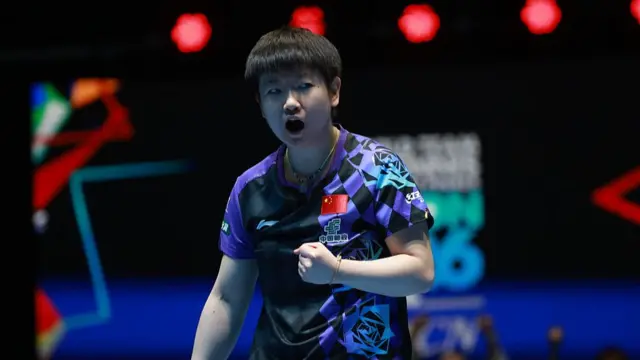
The women's final provided its own moment of high drama. Japan, buoyed by the brilliance of Hina Hayata and the emerging Miwa Harimoto, pushed China hard. It was Sun Yingsha, the three-time Olympic gold medallist and arguably the most dominant women's player of her generation, who delivered when it mattered most. Facing Harimoto in a must-win fourth match after China fell behind, Sun produced a ruthless 11-2, 11-4, 11-6 victory that swung the momentum back in China's favor. Wang Manyu then sealed the title in the decisive fifth rubber.
Sun's ability to elevate her game in moments of crisis remains one of the defining qualities of modern table tennis. Her performance in London reinforced why she is considered the standard-bearer for the women's game, but it also highlighted that opponents are getting closer to matching her intensity.
A Centenary Celebration That Looked Forward
Beyond the elite competition, the London 2026 Championships served as a powerful reminder of table tennis's universal appeal. The tournament celebrated the centenary of the sport's first world championships with events that connected the game's past and present. The youngest competitor, Switzerland's Enya Hu, was just 12 years old. The oldest, 73-year-old Wang Qi representing Fiji, became one of the most beloved figures of the tournament despite having his bats ruled illegal before competition began. He borrowed a teammate's racket and played on with a smile, embodying the spirit of a sport that welcomes all ages and skill levels.
ITTF President Petra Sörling captured the moment perfectly, noting that when a 12-year-old and a 73-year-old can both find genuine challenge and joy at the same tournament, you know you have something truly special. The sport now boasts 227 member associations, and participation numbers rank it among the top ten sports globally. The Hollywood movie "Marty Supreme," starring Timothée Chalamet, has only amplified public interest.
What This Means for the Road to the 2028 Olympics
The London 2026 Championships served as a critical audition for the 2028 Los Angeles Olympics. Wang Chuqin and Sun Yingsha reaffirmed their credentials as the players to beat, but the tournament made one thing unmistakably clear: the competition is fiercer than it has been in decades. France, Japan, South Korea, and an increasingly competitive field of emerging nations are investing in coaching infrastructure, youth development, and professional pathways that are producing world-class players at an accelerating rate.
China's dominance has not been a ceiling for others — it has been a catalyst, as Sörling put it. The rest of the world is catching up, and London 2026 may well be remembered as the tournament where the balance of power in table tennis began its most significant shift in a generation. The sport's next century promises to be even more thrilling than its first.
Cover Credits BBC

Leave a Reply